
Why a Dry Nitrogen Reading at the Generator Is Not Enough
If you run modified atmosphere packaging, then you already check your nitrogen or CO2 purity. However, purity and dryness are not the same thing.
A dry nitrogen reading at one point in your system does not guarantee dry gas everywhere else. A gas can also read correctly for oxygen or carbon dioxide percentage and still be too wet.
That extra moisture does not stay harmless. For example, above a water activity of roughly 0.85, it allows mould to establish itself inside a pack that looked fine at sealing.
In powders, moisture bridges particles into lumps. These can block dispensing systems. Meanwhile, in snacks and baked goods, moisture softens the structure that gives a crisp product its snap. This can happen well before the best before date.
None of this shows up on the line. Instead, it shows up later, in a customer complaint, a returned pallet or a failed shelf life trial. By then, the gas may have been causing damage for weeks.
Most plants check dryness once – at the generator and call it done. It is a reasonable instinct. That is where the gas is made and it is the easiest point to instrument.
However, a single dry nitrogen reading only confirms that the gas was dry at that moment. It also confirms that it was dry at that specific point. Consequently, it says nothing about what happens to the gas afterwards.
Where the Gas Actually Picks Up Moisture
The run between the generator and the point of use is where things can go wrong.
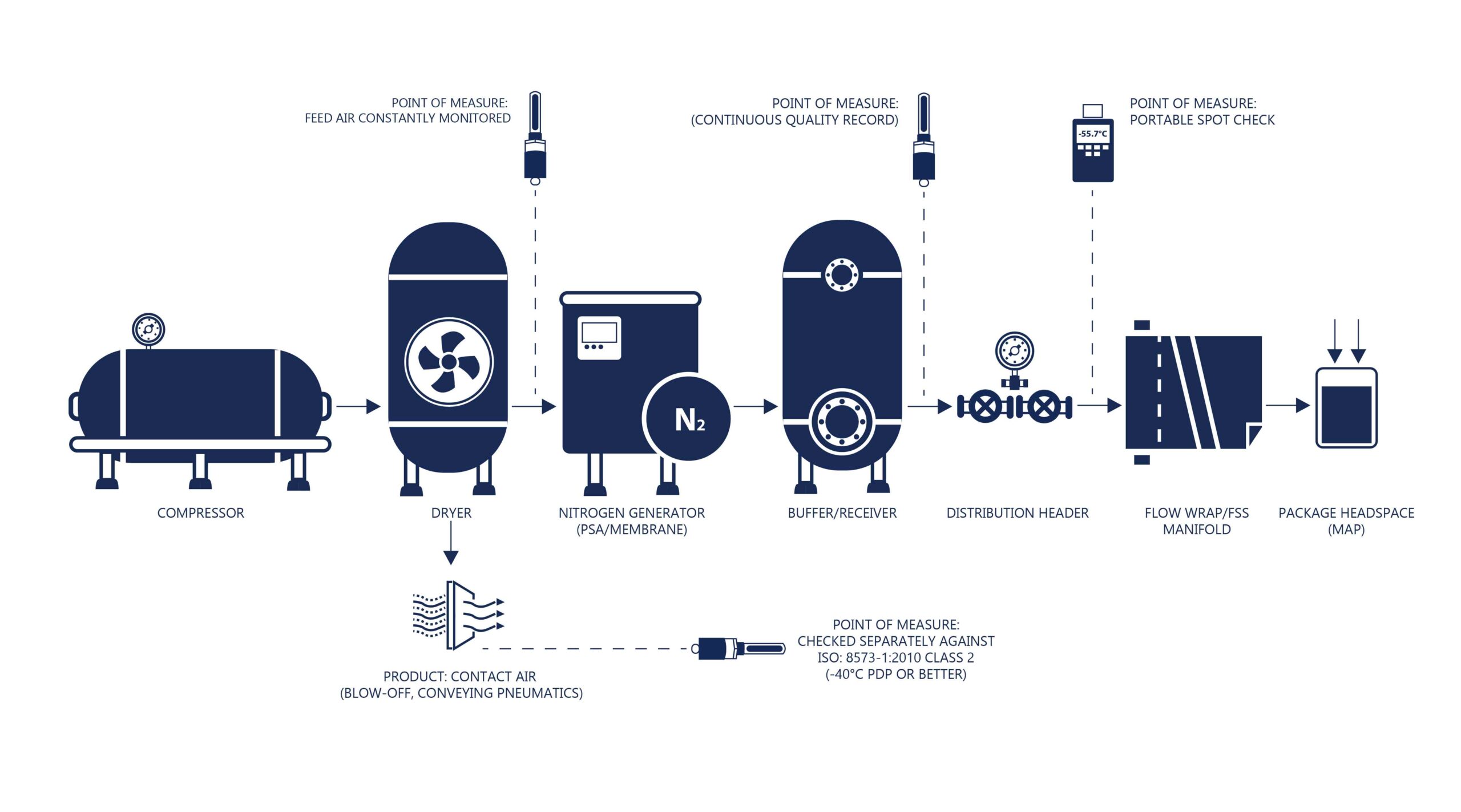
In practice, this happens in a few specific ways. For instance, a quick connect coupling on a hose line can allow ambient air back into the system. A hose left open between production runs can do the same.
Opening a gas manifold for changeover creates a similar risk on a smaller scale. Because this can happen on every line and at every changeover, it becomes a routine risk rather than an occasional one.
The second cause is less obvious. In this case, nothing opens at all. For example, a distribution pipe may run through a colder part of the plant. This could be near a loading dock, an exterior wall or an unheated section of ceiling void.
There, the pipe wall itself can drop close to the gas’s own pressure dewpoint (PDP). When that happens, water condenses out of the gas. It collects on the inside of the pipe, even though the header read comfortably dry upstream.
The gas was genuinely dry when it left the buffer receiver. Nevertheless, it did not stay that way.
Both failure modes have the same signature. The generator readout or header monitor shows a correct number. Yet the gas reaching the package is still wetter than it should be.
Why This Matters Beyond the Packaging Line
This is not the only packaging line problem.
For instance, wet feed air can also degrade the carbon molecular sieve in a PSA generator over time. Therefore, a moisture issue that starts downstream can affect the generator itself.
It may then quietly reduce the purity and dryness of everything the generator produces afterwards.
There is an audit angle too. In addition, most GFSI benchmarked audit schemes ask to see dewpoint monitoring at the distribution header specifically.
As a result, a plant checking only at the generator can still show a compliant number. That number may not reflect what is actually reaching the product.
For plant engineering and QA teams, that is the real concern. Ultimately, a monitoring setup built around one point can pass an audit and still allow moisture related spoilage. The reason is simple: the audit figure and the point of failure are not in the same place.
Applicable Standards
ISO 8573-1:2010 – Compressed air, contaminants and purity classes, including the water/dewpoint classes, Class 2, pressure dewpoint of -40 °C or better, for direct food contact; Class 4, +3 °C for indirect contact.
EIGA Doc 126/20 – Minimum specifications for food gas applications, covering nitrogen (E941) and carbon dioxide (E290) as food additives, including moisture limits.
SQF Guidance, Apr 2023 – SQF’s “Air and Other Gases” Guidance Document, referenced by GFSI, benchmarked audit schemes, on monitoring compressed air and process gases in food production, including moisture testing considerations.
Read our application note explaining where dewpoint should be measured across a food packaging gas system.
It follows the process from the dryer outlet and generator feed, through the distribution header, to the flow wrap or FFS manifold itself. It also explains which standards apply at each point. These include ISO 8573-1:2010, EIGA Doc 126/20 and SQF’s Air and Other Gases guidance.
Read the application note →
Contact Us
For more information regarding dewpoint measurement in food packaging applications, contact the Shaw team.
Hand Held Hygrometers
Inline Analyzers
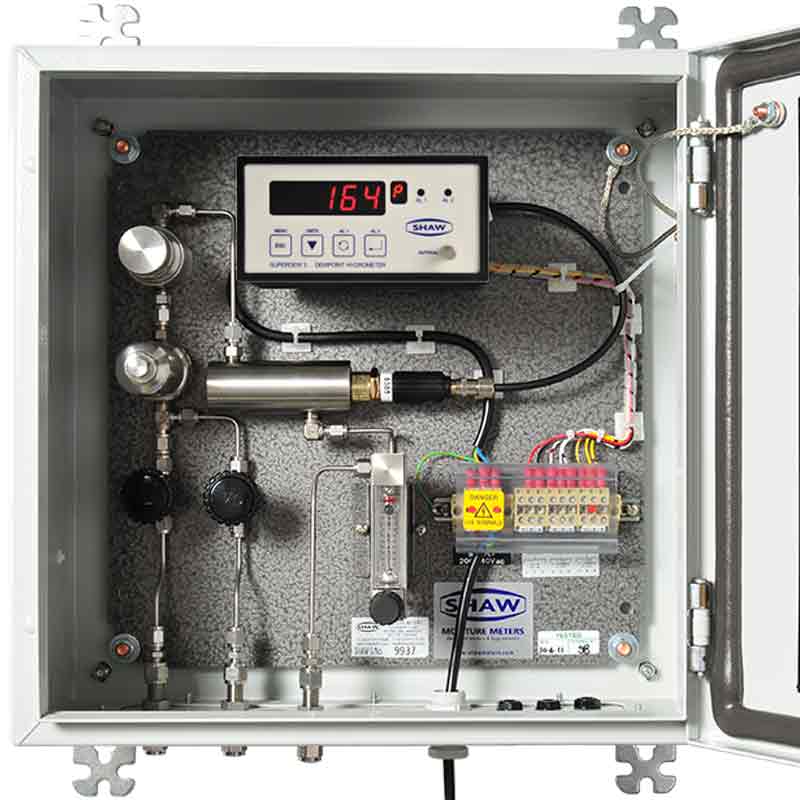
Sample Systems