
Dewpoint measurement in food packaging gas systems doesn’t always give the same reading at every point in the line.
Why Can Dewpoint Differ Between the Nitrogen Header and Packaging Manifold?
Dewpoint measurement in food packaging gas systems doesn’t always give the same reading at every point in the line. This article looks specifically at why readings can differ between the nitrogen header and packaging manifold. For the broader picture across the full gas system, see our application note on trace moisture measurement in food packaging.
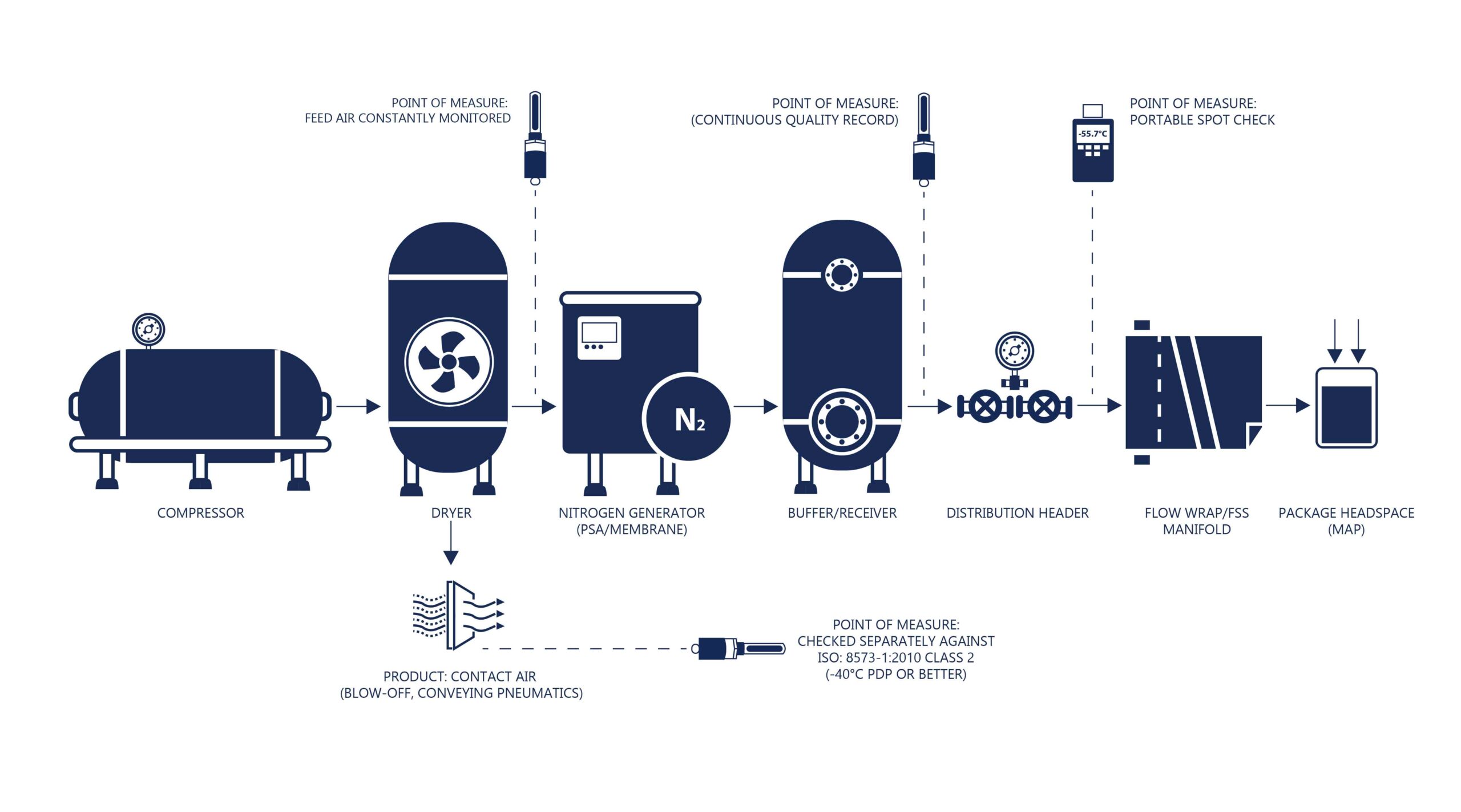
A continuous dewpoint reading at the nitrogen header confirms the condition of the gas entering the packaging hall. A portable measurement at the packaging manifold answers a different question: has that condition been maintained through the downstream distribution system?
If the manifold produces a wetter reading, the difference is not simply an inconsistency between instruments or locations. It may provide useful evidence about where the gas system stopped maintaining the condition established upstream.
For food packaging engineers, comparing these two measurement points can help separate a central gas quality problem from moisture introduced closer to the packaging line.
What Does the Header Reading Confirm?
A continuous reading at the nitrogen or carbon dioxide distribution header establishes the condition of the central gas supply as it leaves the buffer receiver. If the reading is acceptable, the gas is dry at that location and at that time. It provides an ongoing quality record for the packaging hall and establishes a useful reference against which individual lines can be compared.
What it does not prove is that every connected machine receives gas in the same condition. Between the header and the package, the gas may travel through branch pipework, hoses, quick connect couplings and manifolds. Each section becomes part of the measurement question.
Why Might the Point-of-Use Result be Different?
A difference between the header and manifold readings directs attention towards the downstream distribution path.
A hose left open between production runs can admit ambient moisture. A quick connect coupling may expose the line when it is disconnected. Opening a manifold during a changeover creates another opportunity for moisture to enter a system that previously read dry.
The surrounding temperature may also matter. If gas pipework passes through a colder part of the plant and the pipe wall approaches the pressure dewpoint of the gas, condensation can form. The header reading may remain acceptable because it represents conditions upstream of that colder section.
In each case, the source gas may have met the required condition. The change occurred during distribution.
Why Compare Measurement Locations?
A single dewpoint result tells an engineer about one measurement point. Comparing two results begins to describe what happened between them.
If the header and manifold readings are similar, the gas condition has been maintained through that part of the distribution system.
If the point of use result is wetter, the investigation can focus on the relevant branch, hose, coupling, manifold or temperature condition rather than immediately treating the issue as a central nitrogen generation fault.
This does not remove the need to monitor the dryer outlet or generator feed. Wet compressed air can reduce the separation efficiency of the carbon molecular sieve in a pressure swing adsorption nitrogen generator. An upstream measurement remains important for identifying a dryer or feed air problem – see our application note on dewpoint measurement in compressed air dryers for more on monitoring at that point.
The distinction is diagnostic: An upstream reading helps establish whether dry gas was produced. A point of use reading helps establish whether that condition was maintained.
When is a Manifold Check Particularly Useful?
A portable check is especially relevant after the distribution system has been opened or changed. Portable dewpoint meters and hygrometers are suited to this kind of spot check at multiple points across a distribution system.
A line changeover, disconnected hose, opened manifold or work on the gas pipework can alter conditions downstream of the fixed monitoring point. Long or exposed pipe runs also merit attention, particularly when they pass through colder parts of the production environment.
The purpose is not simply to collect another reading. It is to compare conditions at locations that answer different engineering questions.
Dewpoint Measurement in Food Packaging: From Header to Investigation
Continuous and portable dewpoint measurements perform complementary roles.
Dewpoint measurement in food packaging gas systems works best as a comparison, not a single check. The continuous header reading provides the reference for the central supply. A portable measurement at the flow-wrap or FFS manifold tests whether an individual line still reflects that reference.
When the readings differ, the investigation focuses on the distribution route between them. That is why measuring dewpoint only at the nitrogen source can leave a blind spot. It confirms the starting condition, but not necessarily the condition of the gas entering the package.
The next question is where fixed and portable measurements should be positioned across the complete gas system.