
Why Measuring Dewpoint at the Dehumidifier Isn’t Enough in a Lithium-Ion Dry Room
A reading at the dehumidifier outlet tells you the condition of the supply air. It does not necessarily tell you what your cells and materials are exposed to throughout the dry room.
In many lithium-ion plants, the local dry-room atmosphere surrounds the cell during much of its assembly. The relevant condition for exposed materials and open cell operations is therefore the atmosphere at the point of use – not simply the air leaving the dehumidifier.
Here is why that distinction matters and what to do about it.
What the Supply Reading Can and Cannot Tell You
A fixed dewpoint transmitter at the dehumidifier outlet confirms the condition of the air at that measurement point. It cannot show which moisture specification each zone is meeting and different zones may have different requirements.
Plants may divide a dry room into zones because process stages do not have the same moisture sensitivity. Typical targets may range from approximately −30 °C to −45 °C for many cell assembly operations, while electrolyte filling, lithium metal processes and other highly moisture sensitive work may require approximately −50 °C to −60 °C or lower. Actual limits depend on the chemistry, materials, process and plant specification.
Why Lithium-Ion Dry Room Dewpoint Targets Are So Tight
Moisture can promote degradation of the LiPF₆ conducting salt and the formation of hydrofluoric acid (HF). Moisture can also affect electrode surfaces, destabilise the electrolyte and alter solid-electrolyte interphase (SEI) formation.
These effects can reduce cell performance, while other side reactions can generate gas and cause sealed pouch cells to swell. They can begin during manufacturing before the cell is sealed and may contribute to longer term performance and safety problems.
Dry room performance depends on more than the dehumidifier’s rated capacity. Moisture loads from people, door operation, material transfer, air leakage and process equipment can all affect the final room condition.
Engineers must therefore calculate the total moisture load and verify dry room performance at representative points throughout the space – not only at the dehumidifier outlet.
Where Moisture Enters After Supply
People, door and airlock operation, material transfer and air leakage can all be significant moisture loads in a dry room.
Engineers should check airlocks and material transfer points as part of the measurement plan. Some plants install additional sensors there so operators can detect moisture entering through door operation, leakage or inadequate purge performance before it affects the wider zone.
Electrolyte filling and other moisture sensitive operations often have some of the strictest atmospheric requirements. Gloveboxes and local enclosures should be monitored using the measurement points and methods specified for those systems, rather than assumed to match the surrounding dry room air.
What A Practical Measurement Plan Looks Like
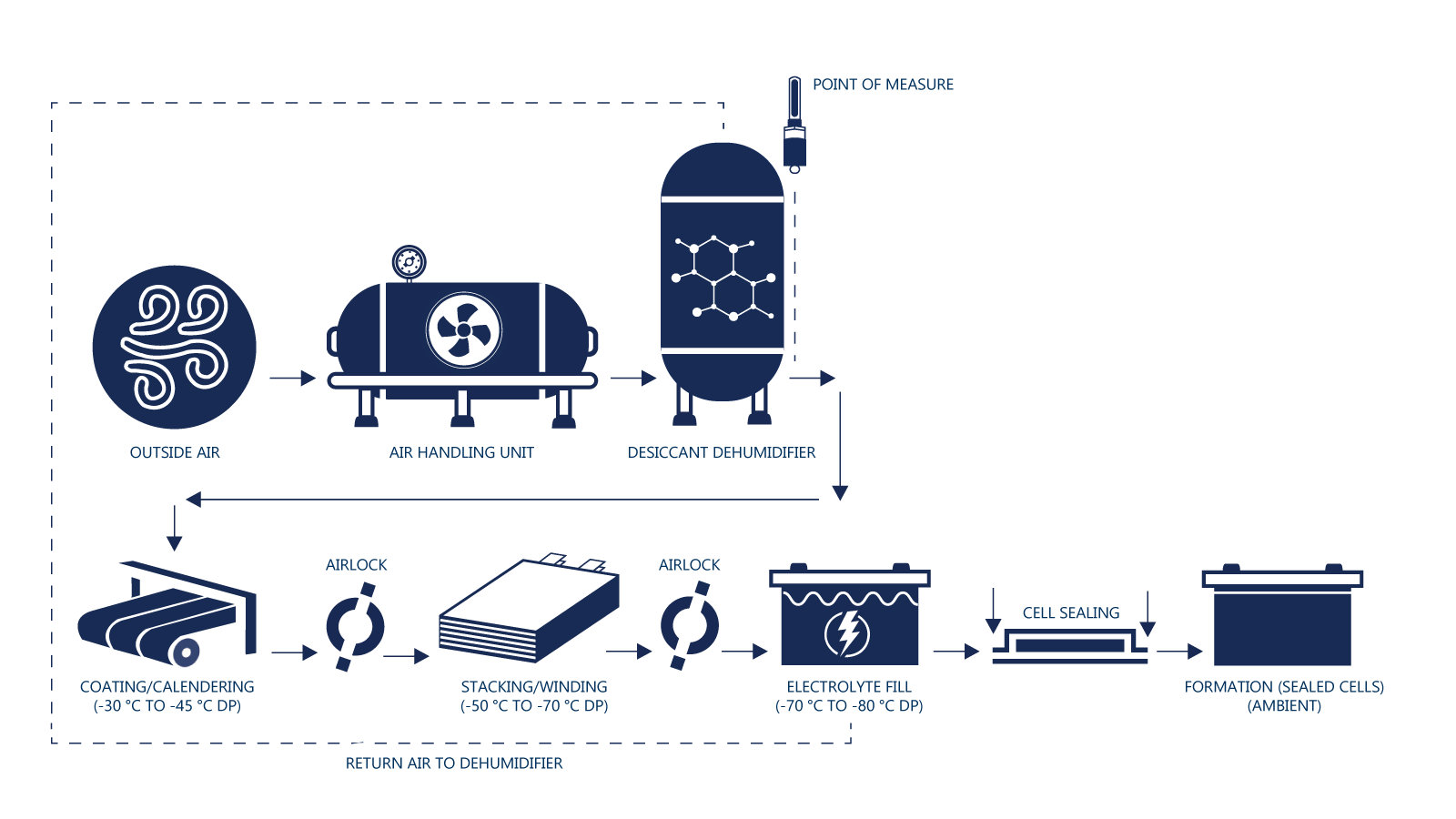
Measure dry room dewpoint continuously in each zone, not only at the supply.
Fixed dewpoint transmitters at the supply and at representative locations in each zone show operators the conditions at those measurement points continuously. Engineers should position sensors according to airflow patterns, process layout and likely moisture entry points.
For commissioning and troubleshooting, a portable hygrometer with fast response and rapid dry down can help engineers survey multiple zones. Engineers can use it to check fixed transmitters independently and locate moisture excursions, provided they control the sampling method, pressure and stabilisation time.
What Dewpoint Cannot Tell You
Dewpoint confirms the atmosphere the electrolyte is exposed to during filling. It does not measure the electrolyte’s own water content once it is sealed in the cell. Laboratories normally determine water content in those materials using a validated method such as Karl Fischer titration. They select the sample preparation method according to the material.
Read the Full Application Note
Our application note, Dewpoint Measurement in Lithium-Ion Battery Manufacture, covers the moisture mechanisms, dry room architecture and measurement locations in more detail.
If you would like help choosing the right combination of fixed and portable instruments for your dry room, please get in touch with our applications team.