
Which do you need?
Dewpoint meter vs transmitter: the right choice depends on whether you need occasional spot checks or continuous monitoring and where the reading needs to go. A portable dewpoint meter suits multi-point checks, while an inline analyser or transmitter provides continuous measurement. Every SHAW dewpoint instrument uses ultra high capacitance aluminium oxide sensing technology.
Dewpoint meter vs transmitter: the key difference
A dewpoint meter gives users a direct moisture reading. A portable dewpoint meter is carried between sample points for spot checks, while an inline moisture analyser provides a continuous local display, alarms and control system outputs.
A dewpoint transmitter does not usually have a display or alarms. Instead, it sends a 4-20 mA signal to an existing PLC, SCADA or BMS, which displays, logs and alarms on the measurement.
In short:
- Choose a portable dewpoint meter for occasional checks at several locations

- Choose an inline dewpoint analyser for continuous monitoring with local indication and alarms
- Choose a dewpoint transmitter when your control system already handles display, data logging and alarms
Choose a portable dewpoint meter for spot checks
Choose a portable dewpoint meter or handheld hygrometer if you need to take measurements in several locations, rather than monitor one point continuously.
Portable dewpoint meters are self-contained, so you can carry one between sample points to check dryers, compressed air lines or gas supplies. They also help confirm readings from a fixed instrument.
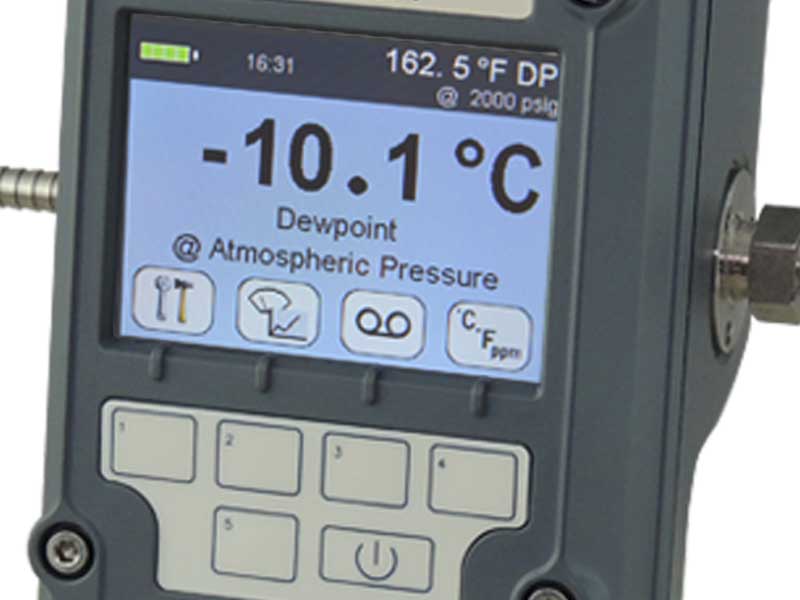
SHAW SDHmini/L
The SHAW SDHmini and SDHmini-L are handheld hygrometers with ±2 °C dewpoint accuracy and more than 150 hours of continuous operation from a fully charged battery. The SDHmini-L stores up to 300,000 time stamped readings and connects by Bluetooth, making it well suited to routine checks, commissioning and record keeping.
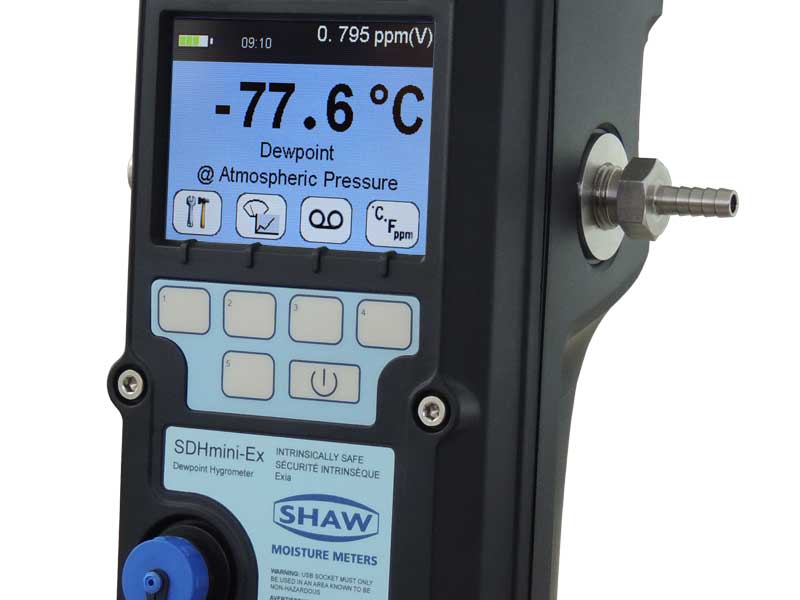
SHAW SDHmini-Ex
The SHAW SDHmini-Ex uses the same handheld design but is certified intrinsically safe to ATEX, IECEx and UL Class 1 Division 1 standards for use in hazardous areas.
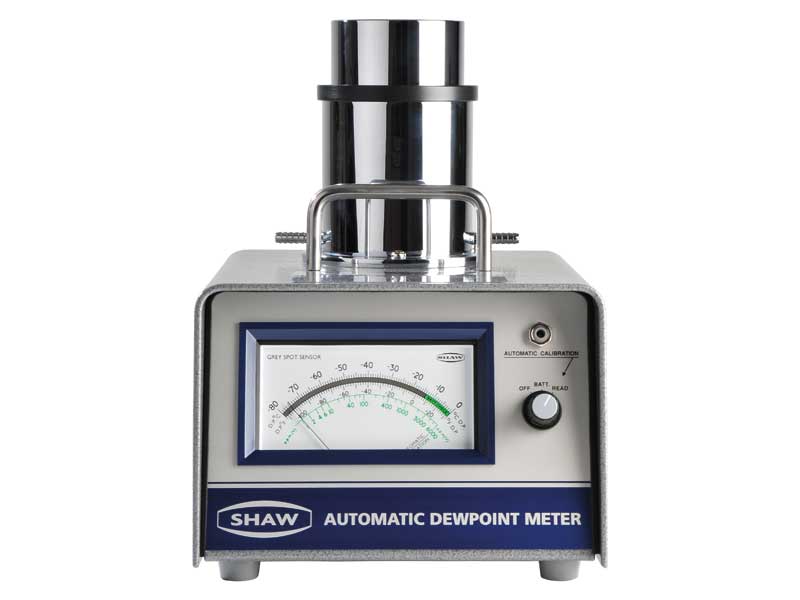
Using a portable dewpoint meter on a pressurised line
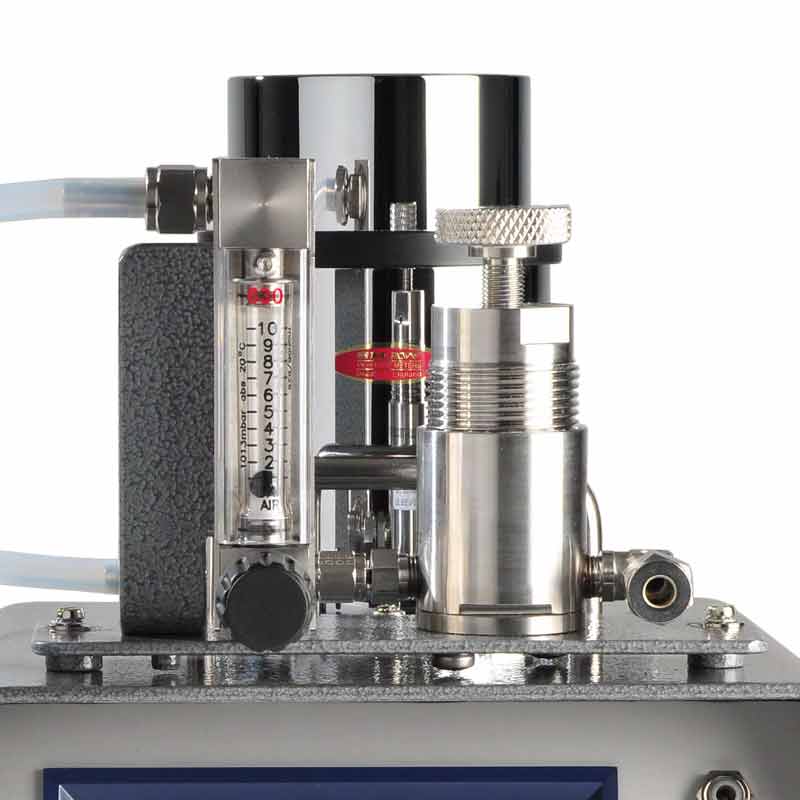
Portable dewpoint meters generally measure at, or close to, atmospheric pressure. On a pressurised air or gas line, use a SHAW sample system to reduce the pressure and control the flow before the sample reaches the meter.
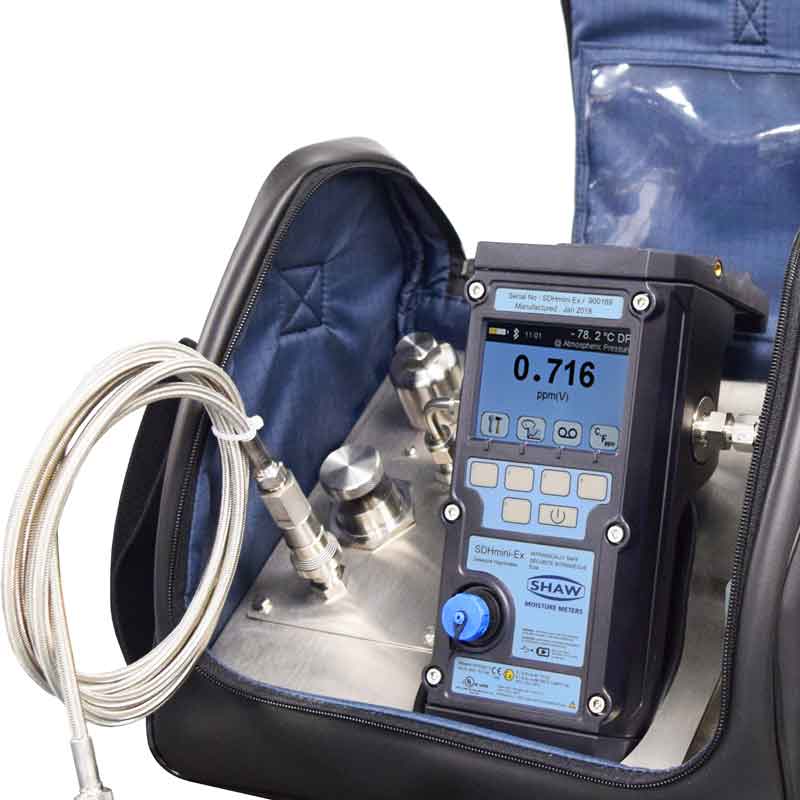
SDH-PSS
SHAW designed the SDHmini Portable Sample System specifically for the SDHmini range of handheld hygrometers. It conditions pressurised gas samples up to 200 barg, providing the correct sample pressure and flow for accurate dewpoint measurement.
Choose an inline analyser for continuous monitoring
Choose an inline dewpoint analyser if you need continuous monitoring at one sample point, with a local display, alarms and an output to your control system.
An inline analyser remains connected to the process, giving operators a live dewpoint reading, alarm relays and a signal for a PLC, SCADA or other control system.
Superdew 3 and Superdew 3 WP
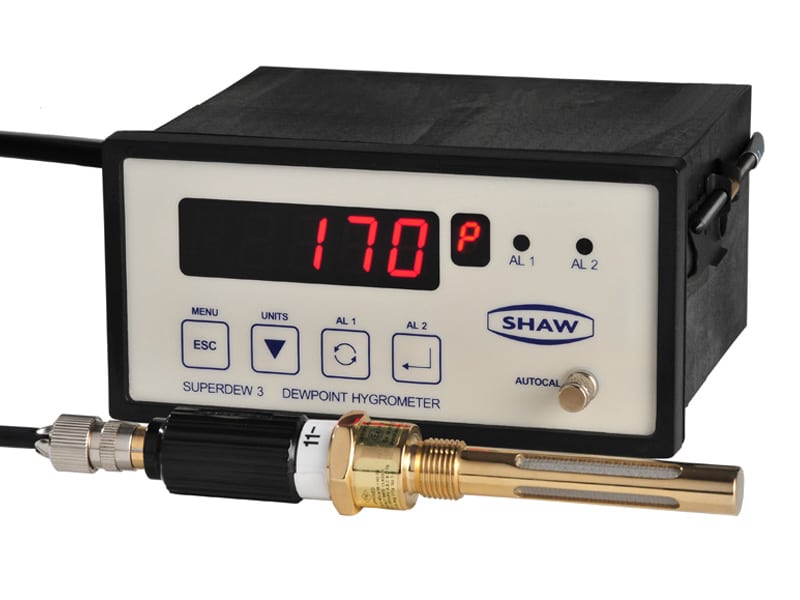
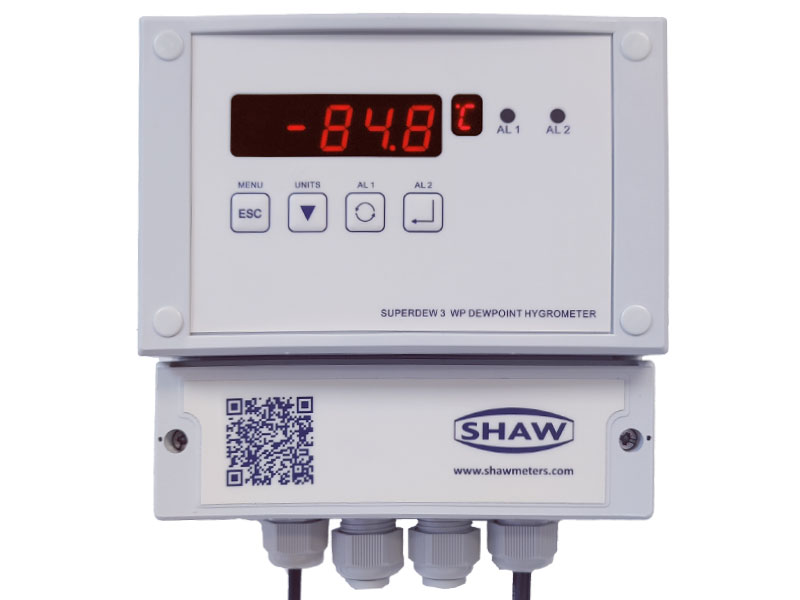
The SHAW Superdew 3 and Superdew 3 WP are single channel inline hygrometers with a measurement range of -100 °C to +20 °C dewpoint.
Both provide two alarm relays and 4-20 mA output. You can site the instrument more than 1,000 m from its sensor, installing the display in a convenient control room or panel location while the sensor remains at the measurement point. The Superdew 3 WP is weatherproof and suitable for wall mount.
AcuTrak
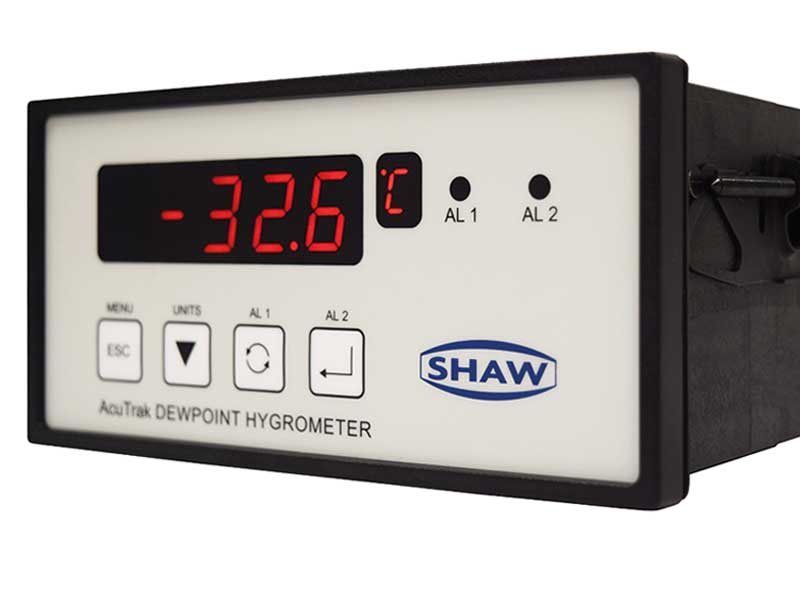
The SHAW AcuTrak is an inline hygrometer used with the AcuDew dewpoint transmitter. It measures from -120 °C to +20 °C dewpoint with ±2 °C accuracy. It provides two programmable alarm relays, a 4-20 mA retransmission output and RS485 communications. This makes it suitable where you need local indication and system integration.
Choose a dewpoint transmitter for PLC, SCADA or BMS integration
Choose a dewpoint transmitter if you only need to send a dewpoint signal to an existing PLC, SCADA or building management system (BMS). A transmitter provides a 4-20 mA signal and has no display or alarms of its own. It is the simplest and most compact way to add continuous monitoring to a system that already logs data and raises alarms.
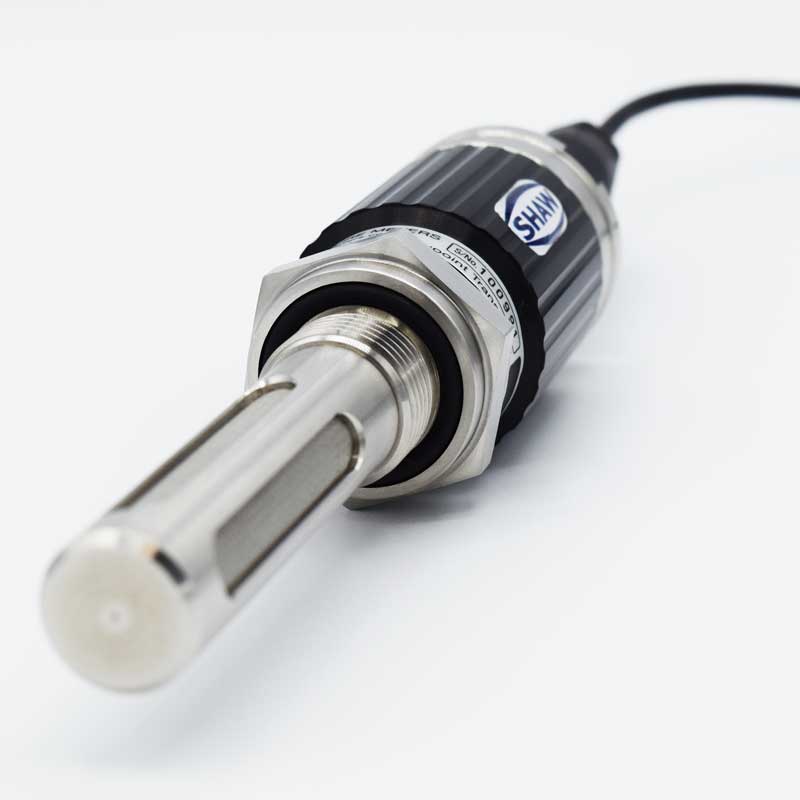
AcuDew
The SHAW AcuDew is a 2 wire, loop powered dewpoint transmitter with a linear 4-20 mA output. It measures from -120 °C to +20 °C dewpoint and withstands pressures up to 350 bar. It can transmit up to 1,000 m without signal loss. You can add an AcuLoop plug-in display or AcuTrak display or AcuVu display later, if you need local indication.
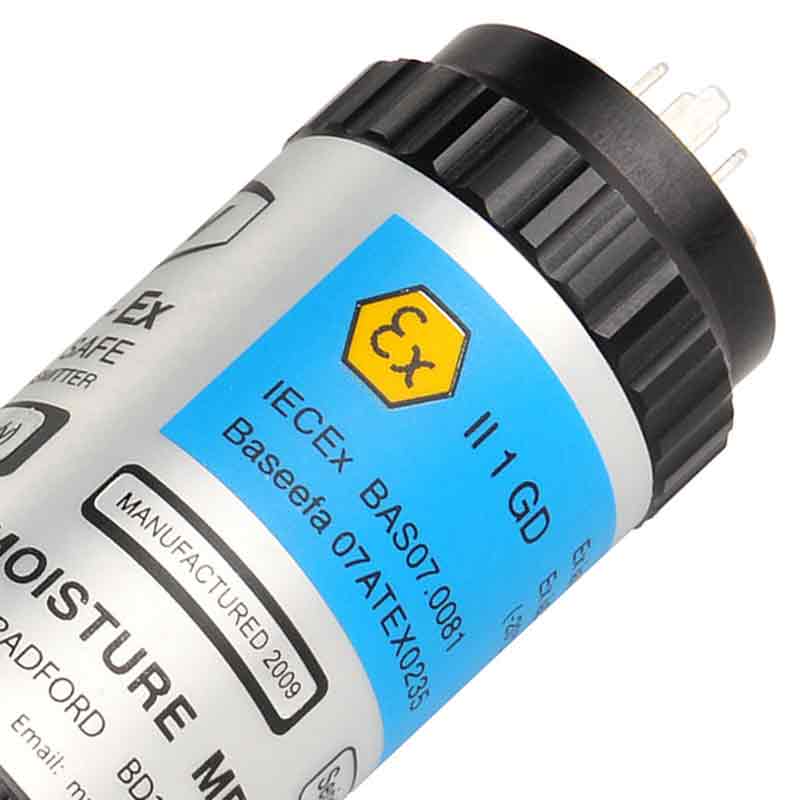
About the aluminium oxide dewpoint sensor
Dewpoint meter vs transmitter: which should you choose?
Choose a portable dewpoint meter if you need to check several sample points. Choose an inline dewpoint analyser if you need continuous monitoring with a local display and alarms. Choose a dewpoint transmitter if your PLC, SCADA or BMS already provides those functions.
Still not sure? Many sites use both approaches
Many sites use both approaches: a fixed transmitter or analyser monitors the critical process continuously, while a portable dewpoint meter checks other points and validates the fixed reading.
Whichever you choose, if you need a sample system then you need the correct one. The SU4 sample conditioning unit or SWS-SD3 weatherproof sample system ensures the gas reaches the sensor at the correct flow and pressure.
Our team can help you compare a dewpoint meter vs transmitter for your application. Call +44 1274 733582 to speak with a moisture measurement specialist.
Dewpoint meter vs transmitter FAQs
What is the difference between a dewpoint meter and a transmitter?
A dewpoint meter provides a direct reading, either on a portable instrument or an inline analyser. A transmitter sends a 4-20 mA signal to a PLC, SCADA or BMS and normally has no display or alarms of its own.
When should I choose a dewpoint transmitter?
Choose a dewpoint transmitter when you need continuous measurement and your control system already displays the reading, log data and raise alarms.
When is a portable dewpoint meter the better choice?
A portable dewpoint meter is best for spot checks at multiple sample points, commissioning, troubleshooting and validating fixed instruments.
Can a portable dewpoint meter measure a pressurised line directly?
Portable dewpoint meters are generally intended to measure at or close to, atmospheric pressure. Use a suitable sample system, such as the SDH-PSS, SU2, SU3, SU4 or SWS-SD3 to reduce pressure and control sample flow.
What sensor technology does SHAW use?
SHAW dewpoint instruments use ultra high capacitance aluminium oxide sensor technology for trace moisture measurement in compressed air and industrial process gases.