
A great many of our instruments are used in potentially hazardous areas where there is a high risk of fire or explosion. Petrochemical works and oil/gas platforms are two obvious cases but there are many others involving the use of hydrogen or other dangerous gases.
There are two types of use to be considered:
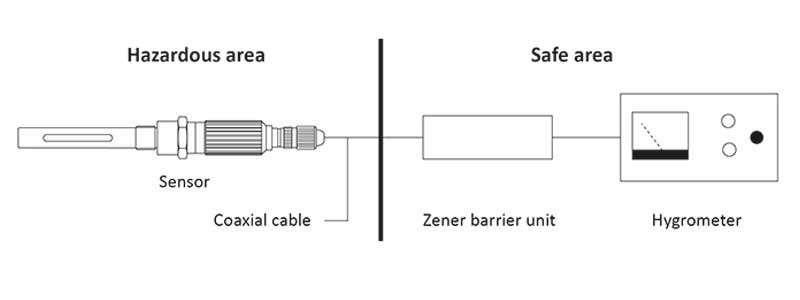
Simplified version of reference Baseefa 2001 311 Iss 1
1. Spot-check readings where the instrument has to be within the hazardous area
The SADP has three weeks of daily laboratory checks at our head office, subject to stringent ISO 9001:2015 quality control and traceable to the National Physical Laboratory (NPL). Every meter is UKCA and CE marked and certified intrinsically safe to ATEX and IECEx standards – ATEX: Ex II I G Ex ia IIC T6 Ga and IECEx: Ex ia IIC T6 Ga.
2. Mains powered instruments where continuous operation is needed
However, it is possible to locate the instrument itself in a safe area. Where a safe area is available for the location of the instrument, the sensor may be placed in the hazardous area using a signal isolator/zener barrier unit between the instrument to sensor cable, providing protection to BASEEFA 2001. The system certification is: SYST baseefa03Y0070, Barrier Certification: BASO1ATEX7202.